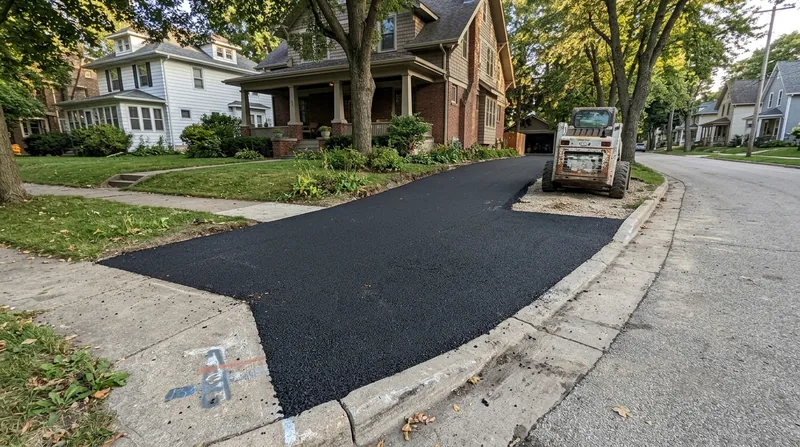




Madison's narrow isthmus lots, mid-century ranch properties, and newer suburban subdivisions often need driveway extensions, widening and aprons to match changing household needs or to tie a new surface cleanly to the street. Whether you are adding width to a single-car drive on a tight Capitol Hill parcel, extending an apron to meet municipal curb-cut requirements, or widening a ranch-lot approach to handle two vehicles, the work demands proper grading, a solid base, and a hot mix overlay that bonds to the existing surface and sheds water off your property. We tie new asphalt into the old with a clean butt joint, pitch the surface to clear standing water, and build the base to handle Madison's 48-inch frost line and the freeze-thaw cycles that heave driveways built on thin or uneven stone. The result is a driveway that works with your lot shape and your home's footprint, not against it.
Why Driveway Extensions and Widening Matter on Madison's Mixed Lot Shapes
Madison's residential parcels are as varied as the neighborhoods they sit in. The tight isthmus blocks near the Capitol and near west side squeeze Craftsman and early-1900s homes onto narrow lots with short, steep driveways that barely fit a single car. Mid-century ranches on the drumlin hills often have wider footprints but aging aprons that don't meet current driveway width standards or that drain water back toward the house. Newer subdivisions spreading across Dane County into Sauk, Columbia, Jefferson, Dodge and Rock counties sit on longer lots where a second vehicle, a work truck, or a better approach angle to the street makes sense. An extension or widening solves practical problems: it improves access, adds parking, meets municipal requirements for apron width or curb-cut radius, and protects your foundation by pitching water away from the structure.
- Narrow isthmus driveways gain usable width without consuming more of the lot footprint.
- Aging aprons are extended to meet current municipal curb-cut and setback rules.
- Wider approaches improve vehicle turning radius and reduce the risk of backing into a garage door or fence.
- Proper pitch moves water off the property and prevents pooling near the foundation.
- Extensions tie cleanly to the street and the existing driveway so the whole surface works as one.
Getting the pitch and the base right matters because Madison's glacial soils, high water table near the lakes, and deep frost line mean that a poorly graded extension will heave, crack, and fail faster than the original drive. We make sure the new asphalt sits on a compacted aggregate base, is pitched to shed water, and bonds properly to the old surface so you don't end up with a seam that breaks apart in your first spring thaw.
Key info: A Capitol Hill homeowner in Madison widened a 10-by-18-foot single-car drive to 20 feet to fit two vehicles side by side. The new section was pitched at 2 percent, tied to the existing drive with a 6-inch butt joint, and built on 4 inches of compacted base stone. The whole surface now sheds water properly and has held up through three Wisconsin winters without cracking at the seam.
For more on how to prepare a site and set a proper base, see our page on gravel driveway installation and grading, which covers the foundation principles that apply to every paving job.
How We Handle Driveway Extensions, Widening and Aprons in Madison
A driveway extension or widening begins with a site visit to measure your lot, understand your drainage, check for utilities, and verify what your municipality allows. Madison and its surrounding towns have different rules about apron width, curb-cut radius, impervious-surface limits, and whether a permit is required. We help you understand those rules and work with your local building department to make sure the design and scope are compliant before we break ground. Once we have a plan, we excavate the new area to remove topsoil and any existing material, proof-roll the subgrade to check for soft spots, lay down a compacted aggregate base (typically 4 to 6 inches of crushed stone), and then pave the new section with hot mix asphalt in two courses: a binder course and a surface course. The new asphalt is troweled to bond to the existing drive, and the whole surface is pitched so water clears the property.
- We measure your lot and existing driveway to determine extension size, width, and pitch requirements.
- We verify local permit and apron rules with your municipal building department before we start.
- We excavate the new area, remove topsoil, and check the subgrade for stability and drainage.
- We place and compact a 4- to 6-inch aggregate base to handle frost heave and distribute wheel loads evenly.
- We pave with hot mix asphalt in a binder course and a surface course, troweling the new section to bond to the existing drive.
- We pitch the entire surface at 2 to 3 percent so water runs off the property and does not pool near your foundation or garage.
The whole process typically takes one to two days for a standard extension or widening, depending on the size of the area and the weather. New asphalt must cure for six to twelve months before you apply any sealcoat, so we recommend holding off on that step until the following year.
Example: A Fitchburg homeowner needed to widen an existing 16-foot driveway to 24 feet to park two vehicles. We excavated 8 feet of new width along the south side, laid 5 inches of compacted base stone, and paved it with 2 inches of binder and 1.5 inches of surface course hot mix. The new section was troweled to bond to the existing drive, pitched at 2.5 percent, and completed in one day. The extension cost $2,400 and held up through the following winter without cracking or settling.
If your existing driveway shows signs of wear or cracking, we may recommend a resurfacing or overlay of the whole surface so the old and new asphalt cure and age together. That approach prevents the seam from becoming a weak point.
Driveway Extension Methods and Approaches
| Approach | Description | Best For |
|---|---|---|
| Butt Joint Extension | New asphalt is laid adjacent to the existing drive and troweled at the seam to bond the two surfaces together. | Widening a driveway or adding length when the existing surface is in good condition. |
| Overlay Extension with Existing Drive | The entire driveway (old plus new) is overlaid with a fresh asphalt layer so old and new age as one unit. | When the existing drive shows moderate wear, cracking, or alligator marks, and you want a seamless finish. |
| Full-Depth Extension | The new section is excavated to subgrade, a fresh aggregate base is placed and compacted, and new asphalt is laid from the bottom up. | When the soil is soft, the subgrade is unstable, or you are extending into an area with poor drainage or high water table. |
| Apron Replacement and Curb Cut | The existing apron is removed, the curb is cut to municipal specifications, and a new apron and drive approach are paved in one operation. | When the apron is failing, the curb cut is undersized, or municipal rules require a wider or properly pitched approach. |
The right approach depends on the condition of your existing driveway, the soil under the new area, local drainage, and what your municipality requires. We assess the site and recommend the method that will hold up longest and cost the least to maintain.
Driveway Extensions, Widening and Aprons Cost in Madison: What to Expect
A typical driveway extension or widening in Madison starts at $1,800 for a modest addition like a 4-by-20-foot section added to an existing drive on stable soil with good drainage. From there, the cost climbs based on the size of the new area, the condition of the subgrade, whether utilities need to be located, whether your municipality requires a permit, and whether you choose to overlay the entire driveway or just tie in a butt joint. A wider extension on unstable soil or in an area with a high water table may require a thicker base, which adds cost. If your existing driveway is cracked or alligator-marked, we may recommend overlaying the whole surface so the new and old asphalt cure together, which increases the total but gives you a seamless result that lasts longer.
The best way to know what your job will cost is to request a free estimate. We measure your lot, assess the soil and drainage, check local permit rules, and provide a written estimate with tonnage and thickness specifications so you know exactly what you are paying for. Most estimates are ready within 24 hours of the site visit.
Factors that move the price up include:
- Size of the extension or widening, measured in square feet of new asphalt.
- Condition of the subgrade and whether the soil is stable or soft and needs extra base stone.
- Proximity to utilities (gas, electric, water, sewer) that must be located before excavation.
- Municipal permit requirements, which vary by town and may add inspection and paperwork time.
- Whether you choose a butt joint tie-in or an overlay of the entire driveway for a seamless finish.
- Drainage challenges, such as a high water table or poor slope, that require thicker base or special grading.
For a complete pricing breakdown and examples of typical jobs, see our pricing page.
Driveway Extensions, Widening and Aprons Near Me: What Madison Homeowners Should Know Before Hiring
Hiring a paving contractor for a driveway extension or widening is a significant investment, and it pays to do it right. Start by getting written estimates from at least two or three contractors in your area. Each estimate should include the size of the area in square feet, the thickness of the asphalt (binder and surface course), the depth and type of base stone, and the total tonnage of material. If an estimate is vague or does not include those details, ask for them before you sign anything. Verify that the contractor is fully insured and check references from recent jobs in your neighborhood. Ask about their approach to drainage and pitch, their warranty on workmanship, and how they handle permits if your municipality requires one. Do not pay a large cash deposit upfront; a reasonable deposit is 25 to 33 percent of the estimate, with the balance due on completion.
Permits and regulations vary by municipality. Madison, Middleton, Fitchburg, Sun Prairie, Verona, Monona, and other towns in Dane County have different rules about apron width, curb-cut radius, setbacks, and impervious-surface limits. Some jurisdictions require a permit for any driveway work that touches the public right-of-way or changes drainage; others do not. If you have an HOA, check your architectural guidelines before you start, as many master-planned communities restrict driveway material or require approval for extensions. Wisconsin law requires a utility locate (Wisconsin 811) before any excavation, and we always call that in before we dig. Your local building department can tell you what is required in your area, and we help you navigate that process.
For a free estimate and a conversation about your project, contact us or call (608) 292-2500. We have been in business since 2011 and serve Madison and the surrounding towns with straightforward, honest paving work.
Driveway Extensions, Widening & Aprons in Madison: Pricing Guide
| Service | Price | Details |
|---|---|---|
| Small extension or widening | Starting at $1,800 | 4-by-20-foot addition on stable soil with good drainage, butt joint tie-in, no permit required |
| Moderate widening or longer extension | Starting at $3,200 | 8-by-24-foot widening, compacted base stone, pitch verification, one day installation |
| Apron replacement with curb cut | Starting at $2,800 | Full-depth removal and new apron installation, municipal curb-cut requirements, permit and inspection included |
| Extension with overlay of existing drive | On estimate | Entire driveway overlaid for seamless finish, cost depends on total square footage and existing surface condition |
| Travel and estimate | Free | No mileage charge in Madison and surrounding areas, free written estimate within 24 hours of site visit |
Indicative pricing, the exact cost depends on square footage, finish, and site access. Free personalized estimate within 24h at (608) 292-2500.


