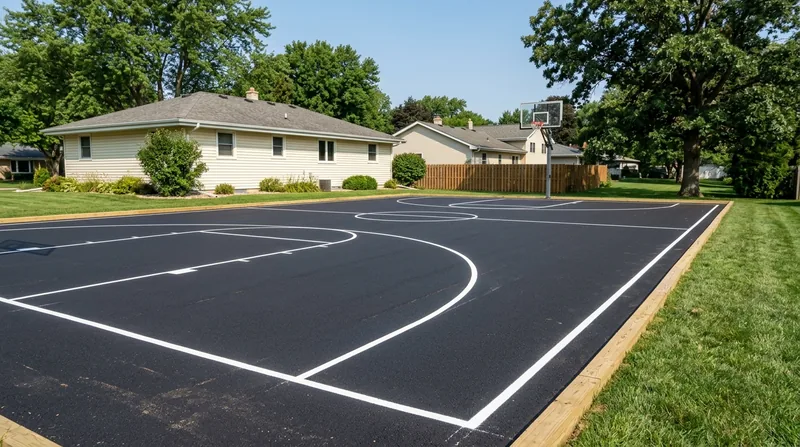




Sports Court & Path Paving in Madison requires a foundation built to handle Wisconsin's deep frost line and the freeze-thaw cycles that crack surfaces laid over weak or uneven base. Madison sits on glacial terrain: the isthmus between Lake Mendota and Lake Monona, the drumlin hills spreading west and south, and peaty wetland soils near the water that stay soft through spring thaw. A tennis court, basketball court, or recreational path paved without proper grading and compaction past the frost line will heave and crack within two or three seasons. We grade and compact the base, pour hot mix asphalt leveled to proper court dimensions, and build surfaces that hold up to the wet Wisconsin spring and the plow damage of a Dane County winter. From residential courts in Fitchburg and Verona to multi-court facilities in Sun Prairie and Waunakee, we handle the full scope: site grading, base preparation, hot mix installation, and the drainage work that keeps water off the playing surface.
Why Proper Base Preparation Matters for Sports Courts in Madison
A sports court is only as stable as the ground beneath it. Madison's frost line sits at 48 inches, the minimum footing depth under the Wisconsin Uniform Dwelling Code, and the spring thaw pushes water upward through soil that has frozen solid for four months. If the base is not compacted past frost depth, ice lenses form in the subgrade, the ground heaves unevenly, and the asphalt surface cracks in a week or cracks in sections. Courts need a compacted aggregate base built to a specification, then a binder course and surface course of hot mix asphalt graded for the load and the climate.
- We excavate and remove unsuitable soil, then bring in compacted stone base past the 48-inch frost line.
- We proof-roll the base to verify compaction and bearing capacity before the asphalt arrives.
- We grade the surface to proper slope so water sheds off the court, not into the base.
- We pour hot mix in two courses, binder and surface, leveled and finished to the dimensions your court or path requires.
- We set up proper drainage at the perimeter so groundwater does not undermine the base in spring.
Courts built this way hold up to the freeze-thaw cycle and remain playable for 15 to 20 years with routine maintenance.
Local example: A residential basketball court in Maple Bluff on the east side sits on sandy outwash soil with good drainage, but the base still must reach below frost depth. A court in Monona near the water table needs extra drainage work because the soil stays wet longer in spring. Both require the same frost-depth excavation.
For detailed information on how we prepare bases for other asphalt surfaces, see our gravel driveway installation and grading service, which applies the same compaction and frost-depth principles.
Wisconsin 811 requires a utility locate before any excavation. Contact 811 before we begin work so we mark gas, electric, water, sewer, and telecom lines. Failure to locate can result in injury, service outage, and liability. See Madison's city website for local utility locate and permitting requirements.
How We Build Sports Courts and Paths Across Madison
The process moves from site assessment through base prep to asphalt installation. We measure the court or path, confirm drainage and slope, excavate to frost depth, compact the base, and pour hot mix in two courses. The work typically takes two to four weeks from start to finish, depending on weather and site conditions. We handle the full scope so you do not have to coordinate multiple contractors.
- We visit the site, measure the court or path dimensions, and assess soil conditions and drainage.
- We obtain or help you navigate any local permits required for grading or drainage changes.
- We call Wisconsin 811 for utility locates and wait for marks before we excavate.
- We excavate unsuitable soil and bring in compacted stone base in lifts, proof-rolling each lift.
- We grade the subbase to proper slope and elevation, then set up edge forms for the asphalt.
- We schedule the hot mix truck, pour the binder course, and finish the surface course to level and texture.
- We allow the asphalt to cure for 48 hours before foot or vehicle traffic, and 7 to 14 days before heavy use.
Once the asphalt has cured, your court or path is ready for play. Do not seal the surface for the first six to twelve months while the asphalt finishes curing and shedding volatiles.
Real example: A multi-court recreation facility in Sun Prairie required grading work to correct a drainage issue on the north side. The site had clay and silt that held water. We excavated to 54 inches, installed perimeter drainage, brought in compacted stone, and poured two courts over three weeks. The facility has been in use for three years with no heave or cracking.
For more on our site grading and base preparation methods, see our parking lot paving service, which uses the same compaction and drainage principles at larger scale.
| Approach | Description | Best for |
|---|---|---|
| Full-depth court paving | Excavate to frost depth, install compacted stone base, pour binder and surface course hot mix asphalt. | New courts, paths, or sites where existing surface is failed or unsuitable. |
| Court resurfacing over existing base | Mill or remove the old surface, verify and repair the base if needed, pour new binder and surface course asphalt. | Courts with sound bases but worn or cracked playing surfaces, reducing excavation and disposal cost. |
| Grading and drainage only | Regrade existing sites, install or repair perimeter and subsurface drainage, compact base without new asphalt. | Courts or paths with adequate surfaces but poor drainage or uneven grading causing water pooling. |
| Path and walking surface paving | Lighter-duty asphalt for recreational paths, bike paths, and walking trails with proper base and slope. | HOA common areas, parks, and residential paths where full court load is not required. |
Sports Court & Path Paving Cost in Madison: What to Expect
Sports court and path paving in Madison starts at $8,500 for a single residential court or path with straightforward site conditions and proper base depth. The final cost depends on the court size, site excavation depth, soil conditions, drainage requirements, and distance from the asphalt plant. A full-depth court on clay soil requiring deep excavation and drainage work costs more than a court on well-draining sand. A multi-court facility or a path with complex drainage costs more still. We provide a written estimate after a site visit, with tonnage specifications and a completion timeline.
Factors that affect the cost include the area to be paved in square feet, the depth of excavation required to reach proper frost depth, the soil type and how much unsuitable material must be removed, whether drainage work is needed, and the distance from your site to the asphalt plant. Getting two or three estimates from local contractors is smart because site-specific conditions vary widely across Madison's terrain. See our pricing overview for additional context on how we quote asphalt work.
Sports Court & Path Paving Near Me: What Madison Homeowners Should Know When Hiring
Hiring a paving contractor for a court or path is a significant decision. Look for a contractor who is local, fully insured, and willing to provide references and a detailed written estimate. Verify that the contractor understands Wisconsin's 48-inch frost line and the compaction standards required for your site. Ask whether permits are required in your municipality and whether the contractor will help you navigate the permitting process. If your court is in an HOA community, check the architectural guidelines to confirm that asphalt is approved and that any color or texture requirements are met.
- Confirm that the contractor is fully insured and able to provide a certificate of insurance before work begins.
- Get a written estimate that includes site dimensions, base depth, tonnage of materials, and a timeline for completion.
- Ask for references from courts or paths built in the last two or three years, and contact them to ask about durability and the contractor's professionalism.
- Verify with your municipality or HOA whether permits are required for grading, drainage, or asphalt paving.
- Confirm that Wisconsin 811 utility locates will be called before excavation begins.
- Avoid contractors who offer unsolicited door-to-door quotes, demand large cash deposits, or refuse to provide a written contract and tonnage specifications.
A local contractor with a Madison address, local plates, and a history of work in the area is your best assurance of quality and accountability. We have been in business since 2011 and are fully insured. Contact us at (608) 292-2500 for a free, no-obligation estimate.
Sports Court & Path Paving in Madison: Pricing Guide
| Service | Price | Details |
|---|---|---|
| Single residential court or path | Starting at $8,500 | Full-depth paving with base prep, compaction to frost line, and two-course asphalt installation |
| Multi-court facility or large path | Starting at $22,000 | Multiple courts or extended paths with complex drainage and grading requirements across the site |
| Court resurfacing (existing sound base) | Starting at $5,500 | Milling or removal of old surface, base repair if needed, new binder and surface course asphalt |
| Grading and drainage work only | On estimate | Site-specific work depends on soil type, drainage complexity, and the extent of excavation required |
| Travel and site visit | Included | No separate charge or mileage fee within Madison and surrounding Dane County service areas |
| Free estimate | No obligation | Written estimate with dimensions, tonnage, and timeline provided within 24 hours of site visit |
Indicative pricing, the exact cost depends on square footage, finish, and site access. Free personalized estimate within 24h at (608) 292-2500.


