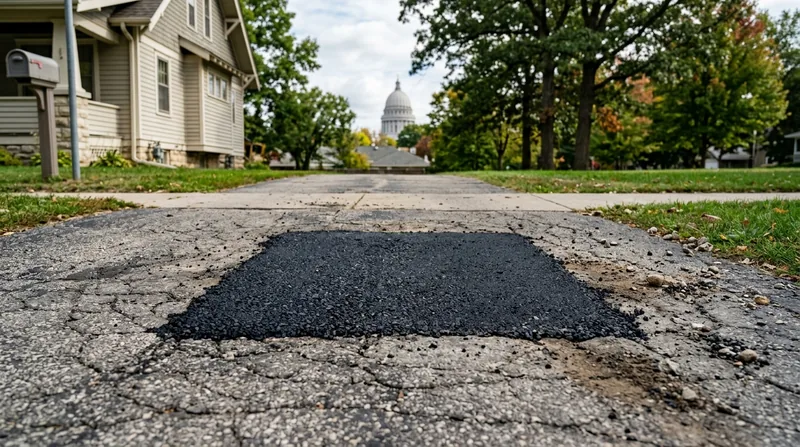




Potholes arrive in Madison every spring without fail. The freeze-thaw cycle that runs from November through April, combined with Wisconsin's 48-inch frost line and heavy winter plowing, cracks the asphalt and heaves the base underneath. When the thaw comes and that broken surface breaks apart under traffic and plow blades, you get a pothole. Pothole repair and asphalt patching in Madison stops the damage before it spreads into your base and costs far more to fix. We clear out the broken material, rebuild the compacted aggregate base for the glacial till and sandy soils under your lot, and install a patch that resists salt, traffic, and the next plow blade.
The residential landscape across Madison, Middleton, Fitchburg, and the surrounding towns runs from tight isthmus parcels near the Capitol, where Craftsman-era houses sit on steep short driveways, out to mid-century ranches on the drumlin hills and newer subdivisions spreading into Dane, Sauk, and Columbia counties. Every lot and every driveway sits on different ground: some on well-draining drumlin rises, others on peaty wetland soils near the lakes that stay soft and heave aggressively. That mix means no two potholes fail the same way, and no two patches hold without understanding what lies beneath. We work the Madison area year-round, but the spring thaw is when the phone rings most, because that is when the winter damage shows up and the window to patch before the warm season closes fast.
Why Pothole Repair Matters in Madison: The Spring Thaw Damage Cycle
Potholes do not form randomly. They grow from a specific failure chain that repeats every winter in Wisconsin. Water seeps into cracks in the asphalt and into the base beneath it. When the temperature drops below 32 degrees Fahrenheit, that water freezes and expands, pushing the asphalt up and cracking it further. When the thaw comes, the water drains away and the asphalt settles unevenly, creating a gap or a depression. Traffic and plow blades then break the weakened edges, and the hole opens up fast. On the isthmus and near the lakes, where peaty soils have a high water table, the heave is worse. On the drumlin hills, where the drainage is better, potholes come later but still come.
- Potholes grow wider and deeper with every freeze-thaw cycle if left unpatched, turning a $500 repair into a $2,000 base rebuild.
- Plow blades catch the edges of a pothole and tear away more asphalt, accelerating the damage through the winter and into spring.
- Water pooling in a pothole weakens the base soil underneath, especially on lots with poor drainage or high water tables.
- A single pothole can signal that the base under a larger section of the driveway is failing, so we always inspect the surrounding surface.
Patching a pothole in April or May, right after the thaw, is the smartest move because it stops the cycle before summer traffic and next winter's freeze make it worse.
Local reality: Madison and Dane County sit on glacial soils with a high water table near the lakes and in wetland areas. Potholes in Monona, Verona, and Sun Prairie often come from base saturation rather than impact alone. We always check drainage and base condition during the estimate.
For more detail on how base failure drives surface problems, see our page on driveway repair in Madison. The Wisconsin Department of Safety and Professional Services (DSPS) provides guidance on residential construction standards at dsps.wi.gov, including frost-line requirements that affect how deep a base must be.
How We Repair Potholes: The Process from Removal to Finish
Pothole repair is not a surface job. We do not just fill a hole with fresh asphalt and hope it holds. We remove the broken asphalt and any soft or water-logged base material, inspect the soil underneath, rebuild the compacted aggregate base to the right depth and density for your lot, and then install the patch. The patch material, thickness, and compaction method depend on the size of the hole and what the base looks like after we remove the debris.
- We clear away all broken asphalt, loose material, and any standing water from the pothole.
- We inspect the base soil and remove any soft, saturated, or unstable material down to firm ground.
- We add compacted crushed stone or recycled asphalt base material to restore the base elevation and density.
- We proof-roll the base with heavy equipment to confirm it will not settle under traffic.
- We install the patch using hot mix asphalt, compacted to match the surrounding surface and the correct density for durability.
- We finish the patch flush with the surrounding pavement so it does not catch plow blades or create a trip hazard.
A small pothole, roughly two feet across, takes two to three hours. Larger areas or multiple potholes on the same driveway take longer because we must handle the base work right.
Example from Fitchburg: A homeowner on the north side had a pothole on a steep driveway built over sandy outwash soil with poor drainage. We removed the pothole, added compacted base, and installed a patch. Six months later, another pothole appeared two feet away. On the second visit, we recommended resurfacing the entire driveway because the base was failing across a wider area, not just at one spot. The patch held because we built it right, but the real problem was the base, not the surface.
If you have multiple potholes or extensive cracking across the driveway, see our page on asphalt resurfacing and overlay to understand when patching stops making financial sense.
Pothole Repair Methods and Materials
| Approach | Description | Best for |
|---|---|---|
| Full-depth patch with new base | We remove all broken asphalt and deteriorated base material, rebuild the compacted aggregate base, and install new hot mix asphalt flush with the surrounding surface. | Potholes on driveways with poor drainage or base saturation, or holes larger than 18 inches across. |
| Shallow patch with base repair | For smaller potholes where the base is mostly intact, we remove the broken asphalt, add a thin layer of compacted base material, and patch with hot mix asphalt. | Isolated small potholes on driveways with a solid underlying base and good drainage. |
| Cold-patch emergency repair | Cold mix asphalt, applied without heating, used only as a temporary fix to stop immediate damage until a permanent hot mix patch can be installed. | Emergency repairs in winter or on weekend calls when hot mix equipment is not available; not a permanent solution. |
| Recycled asphalt base with hot mix patch | We use recycled asphalt millings (RAP) for the base layer, which compacts well, binds over time, and reduces waste, then top with new hot mix asphalt. | Budget-conscious repairs where the base material is not contaminated and the hole is not on a high-traffic area. |
Pothole Repair and Asphalt Patching Cost in Madison: What to Expect
Pothole repair pricing in Madison starts at around $450 for a small isolated hole with a straightforward base repair. The cost moves up based on the size of the pothole, the condition of the base underneath, whether we need to haul away debris, and how much of the surrounding area needs inspection or repair. A pothole the size of a dinner plate costs less than one the size of a car tire. A pothole on a driveway with a failing base costs more than one on a driveway with a solid base. Travel is included in our service area, and we respond to free estimate requests within 24 hours.
The biggest cost variable is what we find when we start digging. If the base is solid, the patch is straightforward. If the base is soft, saturated, or failing across a wider area, we have to go deeper and rebuild more, which costs more. That is why we always inspect the surrounding surface and explain what we find before we give you a final price. A written estimate with tonnage and material specifications lets you compare apples to apples if you get multiple quotes.
If the pothole is one of many across the driveway, or if the driveway has extensive alligator cracking or multiple failed sections, patching becomes less cost-effective than resurfacing. Above roughly 30 to 40 percent of the surface failed, the money belongs in an overlay or resurfacing, not in spot repairs. We are honest about that because it saves you money in the long run.
For a detailed pricing breakdown and to see how pothole repair fits into the larger picture of driveway repair and resurfacing costs, visit our pricing page. Call us at (608) 292-2500 to schedule a free on-site estimate with no obligation.
What to Look for When Hiring a Pothole Repair Contractor Near Madison
Hiring the right paving contractor is not complicated, but it does require you to ask the right questions and verify the answers. The paving trade has a history of itinerant crews showing up with "leftover asphalt from a job nearby" and pushing a large cash deposit and no written contract. That is not how honest work happens. A local contractor with a Madison address, local phone service, and references from neighbors is a stronger signal than a crew that arrives in out-of-state plates and leaves before the patch cures.
When you call for an estimate, ask for the following:
- A written estimate that includes the size of the pothole, the depth of the repair, the base material and tonnage, and the asphalt tonnage and thickness of the patch.
- Insurance coverage details and a certificate of insurance if requested, because paving equipment and traffic carry real risk.
- References from recent pothole repairs or driveway work in Madison or nearby towns, and permission to call them.
- Clarification on whether the estimate includes cleanup and removal of debris, and whether the patch comes with a workmanship warranty.
- Confirmation that the contractor understands local permitting requirements if your driveway apron or drainage changes require a permit from your city or village.
Licensing and permitting for asphalt paving in Wisconsin are set by each municipality, not by the state. Some villages require a permit for any driveway work that touches the apron or changes drainage; others do not. Verify with your local building department whether a permit is required for your pothole repair. If the repair involves extending the apron, widening the driveway, or changing how water drains from your lot, a permit is almost always required. We help homeowners navigate that process, and we always call Wisconsin 811 before any excavation to locate buried utilities.
For more guidance on choosing a contractor and understanding the estimate process, contact us at (608) 292-2500 or use our online form. We are happy to answer questions about our approach and to provide references from past work in your neighborhood.
Pothole Repair & Asphalt Patching in Madison: Pricing Guide
| Service | Price | Details |
|---|---|---|
| Small pothole repair (under 2 feet) | Starting at $450 | Includes removal of broken asphalt, base inspection and repair, and hot mix patch compacted flush with surrounding surface. |
| Medium pothole repair (2 to 4 feet) | Starting at $750 | Larger area requiring more base material and longer compaction time; cost increases with depth of base failure and drainage complexity. |
| Multiple potholes or extensive base repair | Starting at $1,200 | Two or more potholes or a single large area requiring substantial base rebuilding; quoted on-site after inspection of soil and surrounding surface. |
| Emergency or weekend repair | On estimate | Cold-patch temporary repair available within hours; permanent hot mix patch scheduled for next available weekday or weekend slot. |
| Travel and estimate | Included and free | No mileage fee or call-out charge within Madison and surrounding service area; free written estimate with 24-hour response. |
Indicative pricing, the exact cost depends on square footage, finish, and site access. Free personalized estimate within 24h at (608) 292-2500.


